
1. Executive Summary & Asset Economics: Rewinding vs. Replacement
In modern electrical grid management, industrial manufacturing, and power generation environments, medium- and high-voltage power transformers represent critical, capital-intensive infrastructure. As electrical infrastructure worldwide reaches advanced operational ages (often exceeding 25 to 30 years of continuous service), asset managers face a strategic procurement crossroads: perform complete capital replacement or execute comprehensive transformer rewinding services paired with core remanufacturing.
From a financial and operational standpoint, precision transformer rewinding delivered by an OEM-grade facility offers substantial advantages. Rewinding an existing power transformer delivers between 40% to 60% CapEx savings compared to procurement of a new unit. Furthermore, it eliminates the lengthy procurement lead times associated with custom unit design, raw material procurement, and international logistics, reducing project lead times from 12–16 months down to 4–8 weeks.
Information Gain Insight: Embodied Carbon & Asset Acceleration
Beyond direct financial metrics, rewinding an existing transformer retains the existing structural tank, core assembly, magnetic laminations, and radiator assemblies. Retaining these heavy mechanical elements reduces the embodied carbon footprint by up to 70% compared to new transformer manufacturing, directly satisfying corporate ESG mandates and carbon net-zero frameworks.
| Decision Criteria | Complete Unit Replacement | Professional Rewinding & Upgrade |
|---|---|---|
| Capital Expenditure (CapEx) | 100% (High Unit & Civil Costs) | 40% – 60% of Replacement Cost |
| Lead Time (Procurement to Site) | 36 to 52 Weeks (Global Backlogs) | 4 to 8 Weeks (OEM Overhaul) |
| Civil & Substation Modification | High (Dimension & Weight Drift) | Zero (Exact Structural Fit) |
| Thermal & MVA Capacity | Designed to Current Baseline | Upgradable (+15% to +30% MVA with Class H Insulation) |
| Embodied Carbon Impact | High Manufacturing Emissions | Low Carbon Footprint (Core & Tank Reused) |
2. The Physics of Coil Degradation & Failure Diagnostics
Understanding when and why a transformer requires rewinding requires analyzing the thermal, electrical, and mechanical stresses operating on the winding assembly. Over decades of operation, transformers endure continuous thermal cycling, transient overvoltages, switching surges, and severe electromechanical forces resulting from external short-circuit faults.
The primary limiting factor in transformer lifespan is the cellulose insulation (kraft paper) surrounding the copper conductors, immersed in dielectric liquid or encapsulated in cast resin. Electrical paper insulation degrades via three primary mechanisms:
- Pyrolytic Degradation (Thermal Overheating): Sustained high temperatures cause the long polymer chains of cellulose to break down. When the Degree of Polymerization (DP) drops from its initial value of ~1000 down to less than 200, cellulose paper loses virtually all mechanical tensile strength and becomes brittle.
- Hydrolytic Degradation (Moisture Attack): Water content in oil accelerates the depolymerization rate exponentially. Every doubling of water content in solid insulation halves the remaining dielectric life of the cellulose paper.
- Oxidative Degradation: Atmospheric oxygen dissolved in mineral oil reacts with cellulosic fibers, generating organic acids and sludge that foul cooling channels and impair heat dissipation.
Root-Cause Diagnostic Thresholds (DGA & FRA)
Prior to recommending a complete rewind, Federal Power Transformers performs advanced diagnostic profiling including Dissolved Gas Analysis (DGA per IEC 60599), Sweep Frequency Response Analysis (SFRA per IEC 60076-18) to detect winding displacement, and Dielectric Dissipation Factor (Tan Delta) testing to measure moisture content in paper.
3. Federal Power Transformers: Specialized Rewinding Capabilities
Federal Power Transformers LLC (FPT), operating from its state-of-the-art facility in ICAD 1, Abu Dhabi, UAE, maintains full engineering and manufacturing capability for high-complexity transformer repair and remanufacturing up to 100 MVA, 132kV class.
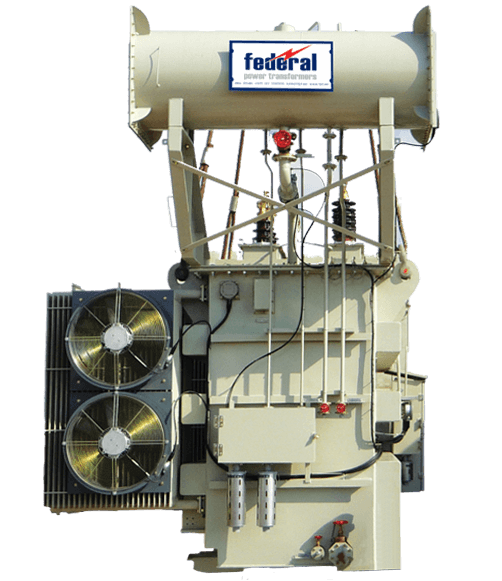
Power & Utility Transformer Rewinding
Engineered rewinding for high-voltage power transformers up to 100 MVA, 132kV. Utilizing Continuously Transposed Conductors (CTC) and high-density pressboard insulation to minimize eddy losses and short-circuit stress.
Get Catalog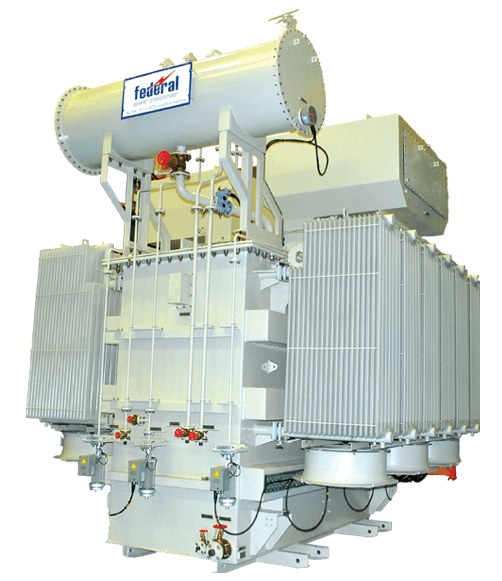
Oil & Gas Severe-Duty Overhauls
Custom coil reconstruction for offshore platforms and refinery substations. Flame-retardant fluid compatibility (synthetic ester), hermetic sealing upgrades, and severe marine environment corrosion protection.
Get Catalog
Cast Resin Dry-Type Coil Rewinding
Complete replacement of damaged cast resin or vacuum-pressure impregnated (VPI) coils. High thermal class F and H resin systems engineered for indoor commercial complexes, data centers, and hospital infrastructure.
Get Catalog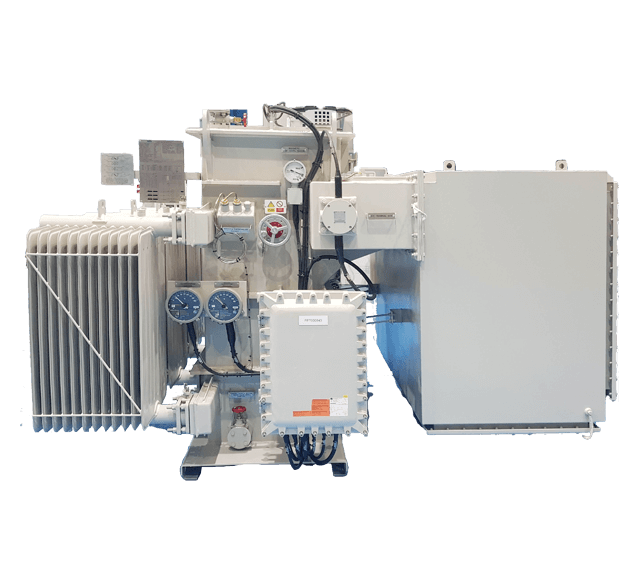
Specialty & Furnace Transformer Repair
Precision remanufacturing of heavy-current arc furnace transformers, rectifier transformers, auto-transformers, and grounding transformers subject to severe harmonics and cyclic thermal shock.
Get Catalog4. Standard Operating Procedure (SOP) for Factory Transformer Remanufacturing
To guarantee original equipment performance and compliance with IEC 60076, ANSI C57, and BS-171 standards, FPT executes a rigorous 7-stage remanufacturing workflow within our dust-free, climate-controlled Abu Dhabi plant.
Stage 1: Deconstruction & Forensic Root-Cause Failure Analysis (RCFA)
The unit undergoes complete untanking and structural disassembly. Engineers inspect insulation degradation, short-circuit copper deformation, and core damage to pinpoint the precise failure mechanism.
Stage 2: Core Stripping & Magnetic Lamination Restoration
The core steel laminations (Grain-Oriented Electrical Steel - CRGO) are disassembled, cleaned, deburred, and re-insulated if needed. Core loss (Watts/kg) is verified to ensure low no-load losses.
Stage 3: Computer-Aided Coil Redesign & Precision Winding
Using CAD and electromagnetic finite element software, windings are redesigned. High-purity Oxygen-Free High Conductivity (OFHC) copper conductors with Class H Nomex or high-grade cellulose insulation are wound onto high-density cylinders.
Stage 4: Axial Pressing & Hydraulic Sizing
Coils undergo hydraulic sizing and axial clamping pressure to ensure that the completed winding structure can withstand maximum prospective short-circuit forces without mechanical displacement.
Stage 5: Vacuum Drying & Vapor Phase Dehydration
The active core-and-coil assembly is placed inside a high-vacuum drying oven. Moisture content in paper insulation is driven down below 0.5% by weight, ensuring maximum dielectric withstand capability.
Stage 6: Tank Refurbishment & Oil Degassing/Filtration
The main transformer tank is sandblasted, integrity-tested, and coated with multi-layer epoxy polyurethane paint systems. Dielectric oil is double-filtered, degassed, and vacuum-filled into the tank.
Stage 7: Full Factory Acceptance Testing (FAT)
Every rewound transformer undergoes comprehensive FAT testing in our high-voltage test bay, including winding resistance, turns ratio, insulation resistance, partial discharge, induced overvoltage, and separate-source AC withstand tests.
5. Future Trends in Transformer Rewinding & Asset Procurement (2025–2035)
As global energy networks integrate variable renewable energy (solar PV, offshore wind) and experience rapid growth in industrial loads (data centers, EV charging corridors), transformer technology is undergoing rapid evolution. Procurement teams evaluating transformer rewinding services must consider key technological trends to future-proof their capital investments:
A. Hybrid Insulation Systems & Thermal Capacity Uprating
Modern rewinding allows asset owners to uprate transformer power capacity (MVA rating) without changing the physical footprint or substation foundation. By replacing traditional Class A cellulose paper (105°C thermal limit) with synthetic aramid insulation (such as DuPont™ Nomex® rated for 220°C Class H), the hot-spot temperature limit of the active winding increases dramatically. This enables thermal capacity uprates of 15% to 30% MVA while retaining existing cooling infrastructure.
B. Integration of Synthetic & Natural Ester Dielectric Liquids
Environmental safety and fire prevention standards (such as NFPA 850) increasingly mandate non-flammable dielectric fluids. During the rewinding process, transformers can be modified and re-engineered for compatibility with synthetic or natural ester fluids (K-class liquids with flashpoints >300°C). Ester fluids offer high fire safety and are fully biodegradable, mitigating soil contamination risks in sensitive ecosystems.
C. Embedded Fiber-Optic Sensing & Smart Transformer Retrofitting
During factory rewinding, modern fiber-optic Distributed Temperature Sensors (DTS) can be directly embedded into the conductor hot-spots of high-voltage windings. These sensors provide real-time, high-accuracy temperature telemetry to online asset monitoring systems. Retrofitting smart online Dissolved Gas Analysis (DGA) equipment and bushings with partial discharge sensors transforms legacy transformers into fully digitized smart assets.
6. Frequently Asked Questions (FAQ) for Global Procurement & Asset Engineers
Rewinding is recommended when the transformer's magnetic core steel (CRGO) and tank structure remain structurally sound, but internal paper insulation has aged, or when the unit has suffered localized winding failure due to short-circuit or surge events. Financial analysis generally favors rewinding when replacement lead times exceed project deadlines or when CapEx savings of 40–60% are required.
Yes. By utilizing modern high-grade copper profiles, optimized conductor geometries, and advanced Class H insulation materials (such as Nomex), FPT engineering can redesign the winding topology to increase MVA capacity by 15% to 30% within the original tank dimensions. Voltage ratios and tap changer steps can also be re-engineered to match updated site requirements.
A complete factory rewinding executed to OEM standards delivers an expected operational lifespan equivalent to a new unit — typically 25 to 30 years. FPT provides full factory warranties backed by factory acceptance testing (FAT) verification.
All repair and rewinding operations at our Abu Dhabi facility adhere strictly to ISO 9001:2015 quality management systems. Electrical and thermal designs are validated per IEC 60076 and ANSI C57 guidelines. Every completed unit undergoes full routine and type routine electrical testing prior to dispatch.
No-load (core) losses are governed by the magnetic core laminations. During rewinding, FPT inspects and re-insulates core plates to maintain low core losses. Load losses (I²R copper losses) are often reduced compared to older legacy designs because modern conductor materials and optimized winding arrangements improve total energy efficiency.
Yes. FPT maintains dedicated emergency response capability for industrial, power utility, and oil & gas clients across the GCC and global markets. Rapid untanking, material stocking of copper and insulation, and round-the-clock shift operation allow us to complete emergency rewinding in abbreviated timeframes.
7. Why Partner with Federal Power Transformers LLC
Established in 2006 in Abu Dhabi, UAE, Federal Power Transformers LLC (a unit of Federal Electric) operates a world-class manufacturing plant equipped with dust-free winding cleanrooms, computerized winding machines, automated vacuum drying ovens, and an advanced high-voltage testing lab.
Our core enterprise strengths include:
- Proven OEM Manufacturing Base: We design and manufacture new power transformers up to 100 MVA 132kV, ensuring that our repair team possesses genuine OEM design and engineering expertise.
- Complete Substation Services: In addition to coil rewinding, FPT provides complete On-Load Tap Changer (OLTC) overhauls, bushing replacements, radiator retrofits, and oil reclamation services.
- Target Zero QHSE Culture: Committed to safe, zero-harm, environmentally conscious operations compliant with Abu Dhabi statutory and international standards.
Request a Technical Evaluation & Quotation
Contact our engineering team today to review diagnostic reports, discuss thermal upgrade feasibility, or request a plant audit at our Abu Dhabi facility.