1. Fundamental Architecture & Standards Compliance of Modern Low Voltage Switchgear
In modern industrial, utility, and heavy-commercial infrastructure, Low Voltage Switchgear (LV Switchgear) serves as the critical nerve center for power distribution, circuit protection, motor control, and energy management. Operating at nominal voltages up to 1000V AC and 1500V DC, low voltage switchgear assemblies receive electrical power from step-down distribution transformers (or dry-type transformers) and safely distribute it across complex facility networks while protecting equipment and operational personnel from electrical faults.
For global B2B procurement managers and electrical project managers, selecting the appropriate switchgear specification requires a rigorous evaluation of international standards, environmental stress parameters, short-circuit withstand capabilities, and operational continuity requirements. The global benchmark governing low voltage switchgear and controlgear assemblies is the IEC 61439 standard series (specifically IEC 61439-1 for general rules and IEC 61439-2 for power switchgear and controlgear assemblies), which superseded the legacy IEC 60439 standards.
Engineering Gain: Why IEC 61439 Verification Supersedes Legacy Type Testing
Unlike the former IEC 60439 standard which categorized equipment into rigid "Type-Tested Assemblies (TTA)" and "Partially Type-Tested Assemblies (PTTA)", IEC 61439-1/2 mandates 13 specific Design Verifications. These verifications combine physical testing, calculation algorithms, and strict design rules to guarantee that temperature rise, short-circuit withstand rating ($I_{cw}$), clearance/creepage distances, and mechanical functionality remain uncompromised across customized panel configurations.
Key Electrical Performance Parameters for Global Procurement
When specifying low voltage switchgear for harsh industrial environments, oil & gas plants, or mega-scale infrastructure projects, project engineering teams must define the following core parameters:
| Technical Parameter |
Standard Engineering Range |
Federal Electric Design Benchmark |
Global Compliance Standard |
| Rated Operational Voltage ($U_e$) |
400V / 415V / 690V AC |
Up to 1000V AC / 1500V DC |
IEC 61439-2 / IEEE C37.20.1 |
| Rated Insulation Voltage ($U_i$) |
800V / 1000V AC |
1000V AC / 12kV Impulse ($U_{imp}$) |
IEC 60947-1 |
| Rated Main Busbar Current ($I_n$) |
800A to 5000A |
Up to 6300A (Continuous Duty) |
IEC 61439-2 Thermal Limits |
| Short-time Withstand Current ($I_{cw}$) |
50kA / 65kA (1 sec) |
Up to 100kA for 1s / 50kA for 3s |
IEC 61439-1 Clause 10.11 |
| Peak Short-circuit Current ($I_{pk}$) |
105kA to 143kA |
Up to 220kA Peak |
IEC 61439-1 |
| Internal Arc Containment (IAC) |
Criteria 1 to 5 Passed |
50kA / 65kA for 0.1s - 1.0s |
IEC 61641 / TR 61641 |
| Forms of Internal Separation |
Form 1 through Form 4b |
Form 2b, Form 3b, Form 4a, Form 4b |
IEC 61439-2 BS EN 61439-2 |
| Ingress Protection Rating (IP) |
IP31 to IP54 (Indoor/Outdoor) |
IP42 / IP54 / IP65 NEMA 4X equivalent |
IEC 60529 |
Understanding Forms of Internal Separation: Form 1 to Form 4b
Internal compartmentalization protects personnel against accidental contact with hazardous live parts and prevents solid foreign bodies or internal arc debris from migrating across functional units. The selection of internal separation form directly dictates maintenance safety and operational downtime:
- Form 1 & Form 2: Basic assemblies with no internal separation (Form 1) or separation of busbars from functional units (Form 2a/2b). Primarily utilized in commercial buildings where system shut-down during maintenance is acceptable.
- Form 3 (Form 3a / Form 3b): Busbars are separated from functional units, and all functional units are individually isolated from one another. In Form 3b, outgoing cable terminals are also separated from the functional units but shared in a common cable chamber.
- Form 4a & Form 4b (The Gold Standard for Critical Process Infrastructure): Functional units are individually compartmentalized, busbars are fully isolated, and outgoing cable terminals are dedicated to individual functional units within their own distinct compartments. Form 4b Type 7 separation ensures that technician intervention in one cable box or motor starter module carries absolute zero risk of accidental contact with adjacent live circuits.
2. High-Performance Low Voltage Switchgear Product Portfolio
Federal Electric provides a complete, custom-engineered portfolio of low voltage distribution assemblies, fully compatible with downstream heavy machinery, renewable energy plants, oil & gas refineries, and utility substations. Designed and assembled in Abu Dhabi, UAE, every switchboard undergoes strict factory acceptance testing (FAT) prior to site deployment.
Main Low Voltage Distribution Boards (MLVDB) / Power Centers up to 6300A
Heavy-duty primary switchboards engineered for high-capacity service entrance power intake from transformers or localized power generators. Featuring air circuit breakers (ACB) with micro-processor trip units, intelligent power metering, and Form 4b compartmentalization.
- Busbar Rating: 1000A to 6300A E-Cu 99.9% Copper
- Short Circuit: Up to 100kA for 1 sec / 50kA 3 sec
- Construction: Fully compartmentalized sheet steel (up to 2.5mm)
- Protection: Advanced arc flash relay integration
Intelligent Motor Control Centers (iMCC) — Fixed & Fully Withdrawable
State-of-the-art iMCC panels engineered for continuous industrial processes. Available in fixed, removable, or fully withdrawable cassette configurations, allowing module maintenance and replacement under live busbar conditions with complete operator safety.
- Starter Types: Direct-on-Line (DOL), Star-Delta, VFD, Soft Starter
- Intelligence: Integrated SIMOCODE / Microprocessor protection
- Separation: Form 4b Type 6 / Type 7 compliant
- Protocols: Modbus TCP, Profinet, IEC 61850 native interface
Sub-Main Distribution Boards (SMDB) & Heavy Industrial Panels
Versatile secondary distribution switchboards utilizing Moulded Case Circuit Breakers (MCCB) and Earth Leakage protection. Optimized for localized power breakdown in commercial towers, manufacturing bays, and infrastructure facilities.
- Current Capacity: 160A to 1250A rated busbars
- Ingress Protection: IP42 / IP54 / IP65 for outdoor ambient
- Enclosure Material: Electro-galvanized sheet metal with epoxy powder finish
- Compliance: IEC 61439-2 type verified design
Solar PV Collector & Battery Energy Storage (BESS) LV Switchboards
Specialized low voltage collection panels engineered for utility-scale solar PV plants and containerized battery storage solutions. Built to withstand high DC components, harmonic distortion, and severe ambient thermal variations.
- Operational Rating: 800V AC / 1000V AC optimized inverter output
- Dynamic Duty: High ambient thermal margin (50°C base rating)
- Protection: Bi-directional breaker protection & surge arresters
- Integration: Direct pairing with cast resin dry-type transformers
3. Global Procurement Trends & Future Outlook for Low Voltage Switchgear (2025–2035)
The global low voltage switchgear market is undergoing a seismic transformation driven by global decarbonization, industrial digitalization, decentralized energy resources (DERs), and stringent occupational safety mandates. Procurement leaders must anticipate these global trends to avoid equipment obsolescence and maximize long-term return on capital investment.
01
Smart Switchgear & Condition-Based Monitoring (IoT)
Traditional reactive or time-based maintenance is rapidly giving way to continuous Condition-Based Monitoring (CBM). Modern LV switchgear incorporates non-intrusive wireless thermal sensors on busbar joints, continuous partial discharge (PD) micro-detectors, and optical arc-flash detection loops. These real-time edge telemetry feeds transmit thermal and electrical health metrics directly to cloud-based asset management platforms via IoT gateways, preventing catastrophic failures before they occur.
02
SF6-Free Eco-Friendly & Recyclable Materials
With global environmental regulations tightening (such as EU F-gas phase-outs and global Net-Zero initiatives), switchgear engineering emphasizes sustainable insulation media, halogen-free thermoplastics, and 100% recyclable structural metals. Low voltage assemblies are optimized for minimal embedded carbon footprints, high operational energy efficiency, and non-toxic materials throughout their 30+ year service lifecycle.
03
High Ambient Temperature Derating Optimization
With increasing extreme climate events—particularly in the Middle East, North Africa, and Australia—standard switchgear baseline ratings designed for 35°C ambient temperatures are inadequate. Global procurement specifications now mandate advanced thermal finite element analysis (FEA) to guarantee rated performance under continuous 50°C ambient temperatures without thermal runaway or insulation degradation.
04
Active Arc-Flash Mitigation & Ultra-Fast Quenching
Occupational safety regulations (such as NFPA 70E and IEC TR 61641) require minimizing incident arc flash energy levels. Modern LV switchboards feature active arc quenching systems that detect optical light emissions and current spikes simultaneously, triggering ultra-fast protective devices to short-circuit and extinguish internal arcs in under 2 to 4 milliseconds, eliminating shockwave risks to personnel.
05
Modular Skid & Package Substation Integration
To reduce site civil works and field labor costs, EPC buyers increasingly procure factory-assembled, containerized "Plug-and-Play" skid substations. These units integrate low voltage switchgear, high-efficiency oil-filled or cast resin transformers, and medium voltage ring main units (RMU) into a unified, factory-tested structural enclosure ready for immediate energization upon arrival.
06
Cybersecure Digital Communication Protocols
As switchboards join interconnected industrial control networks, cybersecurity has become a mandatory procurement criteria. Switchgear protection relays, energy meters, and programmable logic controllers (PLCs) must comply with IEC 62443 cybersecurity standards, featuring encrypted Modbus TCP, Ethernet/IP, and IEC 61850 communications to resist unauthorized remote tampering.
Need Custom Low Voltage Switchgear Engineering Specifications?
Consult with Federal Electric’s senior engineering team for tailored Single Line Diagrams (SLD), heat dissipation calculations, and competitive global commercial proposals.
4. Frequently Asked Questions (FAQ) for Low Voltage Switchgear Procurement
Below are technical answers to the most frequently asked engineering questions submitted by global EPC contractors, industrial buyers, and utility engineers during technical bid evaluation.
Q1: What is the technical distinction between Low Voltage Switchgear and Low Voltage Switchboards/Panels?
While the terms are often used interchangeably in commercial discussions, electrical standards define a clear technical boundary. Low Voltage Switchgear (typically governed by ANSI C57/IEEE or IEC 61439-2 heavy industrial clauses) generally features drawout Air Circuit Breakers (ACB), high short-time withstand currents ($I_{cw}$ up to 100kA 1s), and full metal-enclosed Form 4 compartmentalization designed for primary service entrance power. Low Voltage Switchboards or Panelboards typically use fixed or plug-in Moulded Case Circuit Breakers (MCCB), lower short-circuit ratings ($I_{cw}$ up to 50kA), and simpler separation (Form 1 to Form 3), serving secondary downstream distribution.
Q2: How does thermal derating impact copper busbar design in Middle Eastern ambient conditions (50°C)?
IEC 61439-1 baseline temperature rise limits are based on a 35°C 24-hour average ambient temperature, with a maximum peak of 40°C. In extreme climates (e.g., desert installations in Abu Dhabi, Saudi Arabia, or Iraq) where indoor substation ambient temperatures can reach 50°C, the allowable temperature rise ($\Delta T$) of copper busbars is significantly reduced. To prevent insulation degradation and joint loosening, Federal Electric engineers apply thermal derating factors (typically 0.82 to 0.88), increase copper cross-sectional area, utilize tin- or silver-plated high-conductivity electrolytic copper (99.9% E-Cu), and optimize enclosure ventilation to ensure continuous operation at full rated current.
Q3: What parameters ensure compliance with Internal Arc Classification (IAC) per IEC 61641?
Internal Arc Containment per IEC 61641 verifies personnel protection in the event of an accidental internal arc fault. To pass IEC 61641 type testing, the switchboard must satisfy five mandatory criteria during an arc duration (typically 0.1s to 1.0s at full short-circuit current):
1. Correctly secured doors and covers do not open.
2. No ejection of hazardous high-mass parts or fragments.
3. No arc-created holes in the external enclosure skin.
4. Vertically placed cotton indicators do not ignite from escaping hot gases.
5. The protective earthing conductor system remains fully functional and intact throughout the fault.
Q4: What are the primary advantages of Drawout iMCC Modules compared to Fixed Type Starters?
Fully withdrawable (drawout) Intelligent Motor Control Centers offer significant operational advantages for continuous-process industries (such as oil refineries, desalination plants, and chemical manufacturing):
• Zero Process Interruption: A faulty starter module can be safely disconnected, racked out to 'Test' or 'Isolated' position, and completely replaced in under 5 minutes without de-energizing the main vertical or horizontal busbars.
• Safety Interlocking: Mechanical and electrical safety interlocks prevent racking the starter drawer in or out while the main circuit breaker is in the closed (ON) position.
• Standardized Interchangeability: Drawout cassettes of identical frame sizes can be swapped across different cubicles instantaneously.
Q5: How does Federal Electric integrate switchgear with upstream power transformers?
As an integrated manufacturing group specializing in both Power Transformers up to 100 MVA, 132kV and Low Voltage Switchgear, Federal Electric provides seamless engineering integration between transformer secondary low-voltage bushings and incoming switchgear main breakers. We offer direct-coupled busduct/busway trunking connections, flexible copper expansion connectors, and fully co-ordinated trip curves between transformer protection relays and main switchgear incoming ACBs, eliminating field interface mismatches.
Q6: What documentation and factory acceptance testing (FAT) accompany Federal Electric switchgear shipments?
Every LV switchboard leaving our ICAD 1, Abu Dhabi facility is delivered with a complete quality assurance dossier, including:
• Comprehensive IEC 61439 Type Test Certificates from internationally accredited independent test bodies (e.g., ASTA, KEMA, or CESI).
• Factory Acceptance Test (FAT) Reports covering dielectric withstand testing (2.5kV 1 min), insulation resistance verification (>100MΩ), primary injection test on protection relays, and mechanical operation checks.
• Fully updated As-Built Single Line Diagrams (SLD), schematic control drawings, structural layout drawings, and complete Operation & Maintenance (O&M) manuals.
5. Corporate Competence, E-E-A-T Authority & Manufacturing Excellence
As a key operating division of Federal Electric, Federal Power Transformers LLC (FPT) brings decades of specialized manufacturing expertise to the global power infrastructure market. Based in Abu Dhabi, United Arab Emirates, our state-of-the-art manufacturing campus located at Plot No 87-A4, Sector N-41, ICAD 1, Mussafah represents one of the region's most advanced electrical manufacturing hubs.
Why Global Procurement Teams Partner with Federal Electric
-
ISO 9001:2015, ISO 14001:2015 & ISO 45001:2018 Certified: Fully integrated Quality, Environmental, and Health & Safety management systems operating under our strict "Target Zero" harm philosophy.
-
State-of-the-Art ICAD 1 Production Facility: Outfitted with climate-controlled, dust-free assembly bays, automated CNC copper busbar punching/bending lines, electrostatic powder coating plants, and high-precision laser sheet metal fabrication.
-
Rigorous Independent Type Verification: All low voltage switchgear designs and transformer products are fully type-tested and certified by global independent testing laboratories in compliance with IEC, ANSI, and BS standards.
-
Synergistic Power System Engineering: Unique capability to design, build, and test complete power package solutions—combining Medium Voltage Switchgear, Step-Down Power Transformers, Busway Systems, and Low Voltage Switchgear into a single guaranteed package.
-
Proven GCC & Global Track Record: Trusted supplier to regional power utilities, oil & gas majors (ADNOCO, DEWA, TAQA, SEWA, OQ), renewable energy developers, and international EPC conglomerates across the Middle East, Africa, Europe, and Asia.
Manufacturing Infrastructure Spotlight
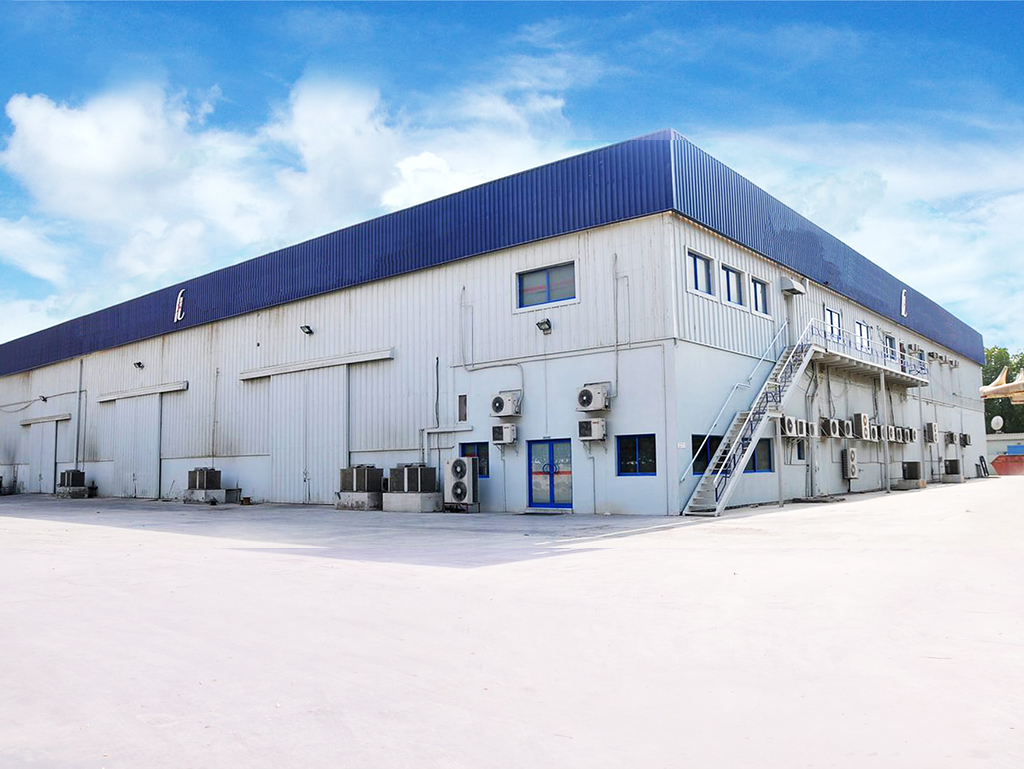
Our Abu Dhabi ICAD 1 campus features fully climate-controlled manufacturing floors and custom routine testing bays equipped to conduct comprehensive electrical, mechanical, and thermal performance testing prior to site dispatch.
Get Catalog